
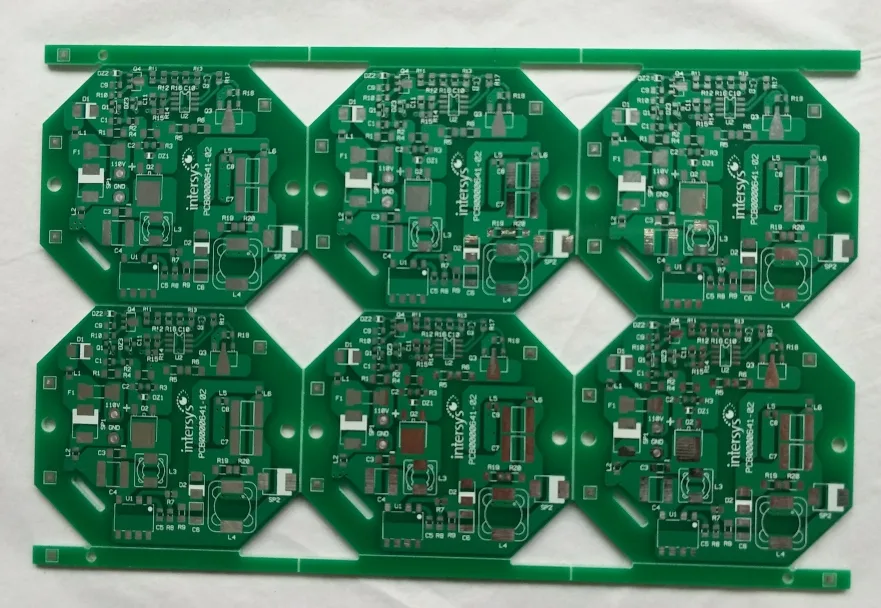
In the vast and intricate world of electronics, there’s one material that quietly forms the foundation of countless devices we use every day: FR4. If you’ve ever wondered what makes up the green board inside your smartphone, computer, or even your microwave, chances are it’s an FR4 Printed Circuit Board (PCB). As a leading PCB manufacturer, we understand the critical role FR4 plays in bringing your innovations to life.
What Exactly is FR4?
FR4 isn’t just a random name; it’s a NEMA grade designation for a glass-reinforced epoxy laminate material. The “FR” stands for Flame Retardant, indicating its self-extinguishing properties, which are crucial for safety in electronic applications. The “4” refers to a specific type of woven fiberglass and epoxy resin composition.
Think of it as layers of woven fiberglass cloth impregnated with an epoxy resin binder, then pressed and heated to create a rigid, stable, and electrically insulating sheet. This sheet then forms the substrate upon which the conductive copper traces of a PCB are laid out.
Why is FR4 So Prevalent in PCB Manufacturing?
FR4 has become the industry standard for a multitude of reasons, striking an excellent balance between performance, cost, and reliability. Here are some of its key advantages:
- Excellent Electrical Insulation: FR4 boasts high dielectric strength, meaning it’s an effective insulator that prevents electrical current from flowing where it shouldn’t. This is fundamental for reliable circuit operation.
- Good Mechanical Strength: The fiberglass reinforcement provides significant mechanical stability and rigidity, allowing PCBs to maintain their shape and integrity even under varying conditions. This makes them robust for assembly and handling.
- Thermal Resistance: While not designed for extreme high-temperature environments, FR4 can withstand typical operating temperatures for most electronic devices without degrading. Its glass transition temperature (Tg), a critical parameter, indicates the point at which the epoxy material begins to soften. Standard FR4 typically has a Tg of around .
- Cost-Effectiveness: Compared to many other high-performance PCB materials, FR4 is relatively inexpensive to produce, making it an economically viable choice for mass production across a wide range of industries.
- Ease of Processing: FR4 is relatively easy to drill, cut, and process using standard PCB manufacturing techniques, which contributes to lower production costs and faster turnaround times.
- Versatility: From single-layer boards to complex multi-layer designs, FR4 can be adapted to various PCB constructions, making it suitable for a diverse array of applications.
Key Properties and Parameters of FR4 PCBs
When discussing FR4, several key properties are essential for engineers and designers to consider:
- Dielectric Constant (Dk or ): This measures how well a material can store electrical energy in an electric field. For standard FR4, Dk typically ranges from 4.3 to 4.7 at 1 GHz. This value is crucial for signal integrity, especially in high-frequency applications.
- Dissipation Factor (Df or ): Also known as loss tangent, Df indicates the amount of energy lost as heat within the dielectric material. Lower Df values are desirable for high-frequency circuits to minimize signal loss. Standard FR4 has a Df of around 0.015 to 0.020.
- Glass Transition Temperature (Tg): As mentioned, Tg () is the temperature at which the epoxy resin transitions from a rigid, glassy state to a softer, rubbery state. A higher Tg indicates better thermal stability. For demanding applications, “high-Tg FR4” with Tg values of or higher is available.
- Thermal Expansion (CTE): The Coefficient of Thermal Expansion (CTE) measures how much a material expands or contracts with changes in temperature. It’s expressed in parts per million per degree Celsius (ppm/). Matching the CTE of the FR4 substrate to that of the copper and components is important to prevent stress and delamination.
- Breakdown Voltage: This is the maximum voltage that the dielectric material can withstand before it breaks down and conducts electricity. It’s a critical safety parameter.
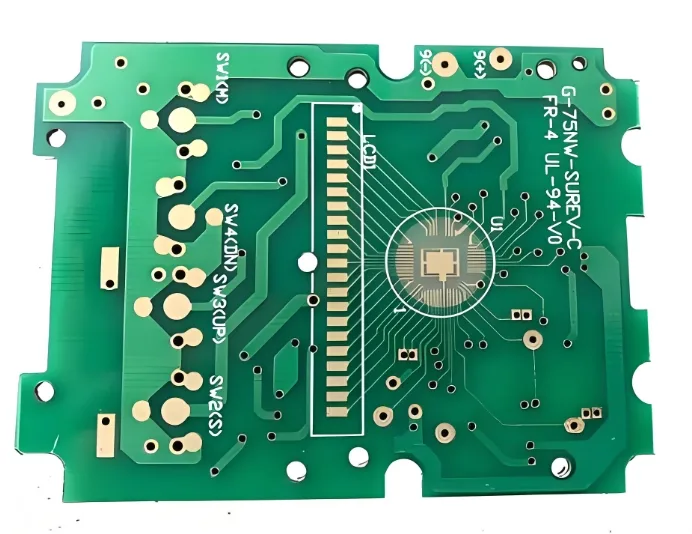
Main Types of FR4 PCBs
FR4 PCBs can be classified from several perspectives, primarily based on their layer count and the enhanced properties of the FR4 material itself.
Layer Count
This is the most common classification, determining the PCB’s complexity and functionality.
- Single-Sided FR4 PCB:
- This is the simplest and most cost-effective PCB type.
- It has a conductive copper layer on only one side, with components typically mounted on the opposite side.
- Ideal for basic electronic products like calculators and LED lighting.
- Double-Sided FR4 PCB:
- These PCBs feature conductive copper layers on both sides, allowing components to be mounted on either side and connected via through-holes (vias).
- They significantly increase circuit density and complexity.
- Widely used in various consumer electronics and industrial control applications.
- Multi-Layer FR4 PCB:
- Composed of multiple alternating layers of conductive copper and insulating FR4 material, pressed together. Connections between layers are made through a complex system of vias.
- These enable very high circuit density and complex functionalities, such as high-speed signal transmission and efficient power distribution.
- Commonly found in computer motherboards, servers, communication equipment, and high-end medical devices. Multi-layer boards can range from 4, 6, 8, or even more layers.
Enhanced FR4 Material Properties
As electronics evolve, standard FR4 may not meet the demands of specific applications. This has led to the development of various enhanced FR4 variants:
- Standard FR4:
- The most widely used type, offering excellent electrical insulation, mechanical strength, and cost-effectiveness.
- Typically has a glass transition temperature (Tg) of around .
- High-Tg FR4:
- “Tg” stands for glass transition temperature. High-Tg FR4 has a higher Tg value, often or more.
- It maintains better mechanical and dimensional stability under higher operating temperatures.
- Suitable for applications requiring greater thermal stress resistance or higher operating temperatures, such as high-power supplies, LED lighting, and automotive electronics.
- Low Dk/Df FR4 (Low Dielectric Constant/Dissipation Factor FR4):
- Dk (dielectric constant) and Df (dissipation factor) are crucial electrical performance parameters.
- For high-frequency and high-speed digital circuits, signal integrity is paramount, requiring lower Dk and Df values to minimize signal loss and delay.
- These FR4 types are often optimized by modifying resin formulations or using special fiberglass weaves, making them ideal for radio frequency (RF) communication and high-speed networking equipment.
- Lead-Free Compatible FR4:
- With the implementation of RoHS directives, many soldering processes have shifted to lead-free solders, which have higher melting points. PCB materials must withstand these elevated soldering temperatures.
- Lead-free compatible FR4 is designed to endure higher thermal cycles and temperature shocks, preventing delamination or other reliability issues during lead-free soldering.
- Halogen-Free FR4:
- Refers to FR4 materials that do not contain halogens (like bromine and chlorine).
- Driven by environmental and safety concerns, many industries require halogen-free materials as halogens can produce toxic gases when burned.
- Increasingly popular in consumer electronics and applications with strict environmental regulations.
- High CTI FR4 (High Comparative Tracking Index FR4):
- CTI measures the resistance of an insulating material’s surface to current leakage. A higher CTI value indicates better electrical insulation performance in humid or contaminated environments.
- Suitable for industrial, medical, or high-voltage applications requiring enhanced safety and reliability.
Other Special FR4 PCB Types
- Thick Copper FR4 PCB:
- Refers to PCBs with thicker conductive copper layers than standard PCBs (e.g., 2oz, 3oz, 4oz, or even thicker).
- These boards can carry higher currents and offer improved heat dissipation.
- Commonly used in power modules, automotive electronics, and high-power LEDs that require high current carrying capabilities.
- Rigid-Flex PCB (combining FR4):
- While FR4 itself is rigid, some applications require the ability to bend or conform to irregular shapes. This often involves combining FR4 with flexible materials (like polyimide) to create Rigid-Flex PCBs.
- Rigid-Flex PCBs offer significant design flexibility and reliability in confined spaces, reducing the need for connectors and cables.
Choosing the right FR4 PCB type depends entirely on your project’s specific requirements, including cost, performance needs (frequency, power, temperature), reliability, and compliance with regulations.
Applications of FR4 PCBs
Given its versatility and robust properties, FR4 is found in almost every electronic device imaginable. Some common applications include:
- Consumer Electronics: Smartphones, tablets, laptops, televisions, gaming consoles, home appliances.
- Automotive Electronics: Engine control units, infotainment systems, lighting controls (though specialized materials are often used for extreme environments).
- Industrial Control Systems: PLCs, motor drives, sensor interfaces.
- Medical Devices: Diagnostic equipment, monitoring systems (non-implantable).
- Telecommunications: Routers, switches, base station components.
- LED Lighting: LED arrays and drivers.
Beyond Standard FR4: Variations and Considerations
While standard FR4 serves a vast array of needs, the evolution of electronics demands specialized versions for more challenging applications:
- High-Tg FR4: For applications requiring greater thermal stability and reliability under higher operating temperatures.
- Low-Dk/Df FR4: Optimized for high-frequency and high-speed digital applications where signal integrity and minimal signal loss are paramount. These materials often feature modified resin systems or specialized fiberglass weaves.
- Lead-Free Compatible FR4: Designed to withstand the higher temperatures associated with lead-free soldering processes.
- Halogen-Free FR4: Environmentally friendly options that eliminate halogens (bromine and chlorine) from the resin, often used to comply with specific regulations.
Choosing the right FR4 variant depends entirely on the specific requirements of your project, including operating frequency, temperature, power handling, and cost considerations.
Conclusion
FR4 PCBs are the unsung heroes of the electronics world, providing a reliable, cost-effective, and versatile platform for countless innovations. At [Your Company Name], we leverage our expertise in FR4 PCB manufacturing to deliver high-quality, dependable boards that form the foundation of your cutting-edge products. Whether you’re designing a simple gadget or a complex industrial system, understanding the properties and advantages of FR4 is the first step towards a successful electronic design.