

In the post-processing stage of PCBA manufacturing, conformal coating spraying is a critical process for improving circuit board protection against moisture, salt spray, mold, acid and alkali corrosion, and thermal cycling stress. Many electronics manufacturers frequently encounter issues such as coating failure, coating cracking, poor heat dissipation, difficult rework, and component short circuits. In more than 90% of cases, these problems are not caused by poor-quality conformal coating materials, but by improper control of coating thickness.
If the coating thickness is too thin, problems such as pinholes and incomplete coverage may occur, preventing the coating from effectively isolating moisture and corrosive substances. Under harsh environmental conditions, this can easily lead to circuit oxidation, leakage current, and short-circuit failures. On the other hand, excessive coating thickness can introduce internal curing stress, cover precision component pins, and hinder heat dissipation. During long-term high and low-temperature cycling, the risk of coating cracking and peeling increases significantly, ultimately reducing the service life of the PCBA.
Based on IPC industry standards, different conformal coating material characteristics, and various application scenarios, this article provides an in-depth analysis of the optimal PCBA conformal coating thickness parameters. It also explains thickness measurement methods, key process control points, and common manufacturing mistakes, helping companies achieve standardized production while balancing protection performance and product reliability. The content is optimized to meet precise Google SEO search requirements.
General Industry Standards for PCBA Conformal Coating Thickness
Currently, the globally recognized specifications for conformal coating thickness in the electronics industry are mainly based on two core standards: IPC-A-610 (Acceptability of Electronic Assemblies) and IPC-CC-830 (Qualification and Performance Specification of Conformal Coatings for Printed Boards and Assemblies). These standards serve as common acceptance criteria for industrial electronics, consumer electronics, automotive electronics, and industrial control equipment.
Key Industry Thickness Parameters (Dry Film Thickness, the Core Mass Production Acceptance Indicator):
- Minimum effective protection thickness: ≥30μm (0.03mm)
Below this value, the coating is prone to pinholes and thin areas, making it difficult to form a complete protective layer. The protective performance is significantly reduced or may completely fail. - General recommended coating thickness: 50μm–100μm
This range is suitable for approximately 90% of conventional electronic products, providing a balanced combination of protection performance, low stress, normal heat dissipation, and convenient repairability. - Maximum safe critical thickness: ≤130μm (0.13mm)
Beyond this thickness, issues such as excessive curing stress, reduced heat dissipation, abnormal encapsulation of precision components, coating cracking, and peeling may occur.
It is important to distinguish that wet film thickness ≠ dry film thickness. The thickness immediately after spraying will decrease due to solvent evaporation and resin curing shrinkage. The typical shrinkage rate is around 30%–50%. During process setup and adjustment, the coating viscosity must be considered for accurate thickness conversion. Wet film thickness should never be used as the final acceptance standard.
Recommended Conformal Coating Thickness for Different Materials
The mainstream conformal coatings available on the market are mainly divided into four categories: acrylic, polyurethane, silicone, and UV-curable coatings. Due to significant differences in viscosity, curing shrinkage, flexibility, and high-temperature resistance, the thickness requirements vary depending on the material type.
The recommended thickness parameters are as follows:
1. Acrylic Conformal Coating
Acrylic conformal coating offers the best cost-performance ratio, excellent versatility, fast curing speed, and easy rework capability. It is widely used in indoor consumer electronics, household appliances, and standard industrial control boards.
Recommended dry film thickness: 30μm–60μm
Process considerations:
Acrylic coatings have low viscosity and excellent leveling performance, so thick coating is generally unnecessary. When the thickness exceeds 60μm, issues such as surface tackiness and incomplete curing may occur. When the thickness is below 30μm, moisture resistance becomes insufficient and the coating may not provide reliable protection in normal humid environments.
2. Polyurethane Conformal Coating
Polyurethane conformal coating provides excellent corrosion resistance, salt spray resistance, and aging resistance. It features high hardness and good wear resistance, making it suitable for outdoor equipment and electronic products operating in harsh industrial environments.
Recommended dry film thickness: 60μm–100μm
Process considerations:
Polyurethane coatings have a dense cured structure. Medium thickness coatings can maximize their corrosion resistance and anti-mold performance. When the thickness is below 50μm, the coating may not effectively withstand salt spray corrosion. When the thickness exceeds 100μm, problems such as brittleness and residual stress may occur.
3. Silicone Conformal Coating
Silicone conformal coating features excellent high-temperature resistance, low-temperature resistance, and flexibility. It is suitable for extreme temperature cycling environments such as automotive engine compartments, outdoor base stations, and high-temperature applications.
Recommended dry film thickness: 80μm–120μm
Process considerations:
Silicone materials have high flexibility and strong stress resistance, allowing slightly thicker coatings to effectively withstand deformation caused by repeated high and low-temperature cycles. However, the thickness should never exceed 130μm, as excessive thickness can seriously affect PCBA heat dissipation efficiency.
4. UV-Curable Conformal Coating
UV-curable conformal coatings offer instant curing, extremely high production efficiency, and no solvent pollution. They are suitable for high-volume automated production of precision electronic products.
Recommended dry film thickness: 40μm–80μm
Process considerations:
UV coatings have very low curing shrinkage and can form dense, uniform protective layers even with relatively thin coatings. Excessive thickness may prevent UV light penetration, causing incomplete curing in the lower layers and resulting in defects such as delamination and layer separation.
Key Factors Affecting Conformal Coating Thickness
① Spraying Process
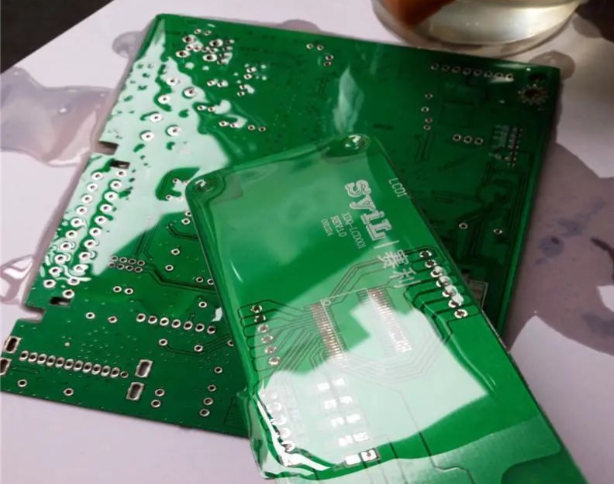
Fully automated selective coating systems use high-resolution piezoelectric spray valves to precisely control material flow rate, spraying speed, and spray height. The coating thickness can be accurately controlled within the range of 30–50μm, with much higher uniformity and consistency compared with manual spraying.
Jiechuang Electronics adopts a fully automated coating production line, with coating thickness uniformly controlled between 30μm–100μm.
② Number of Coating Passes
A thin-layer multi-pass coating process is generally recommended. Applying 2–3 thin coats is better than applying a single thick coat, as it helps reduce issues such as sagging and bubbles while achieving a more uniform and dense protective layer.
③ Type of Conformal Coating Material
Different types of conformal coatings require different thickness specifications. Variations in viscosity and leveling performance among different resin systems, such as acrylic, polyurethane, and silicone coatings, directly affect the achievable coating thickness.
Jiechuang Electronics can provide customized conformal coating solutions according to the requirements of different industries, including industrial control, medical electronics, automotive electronics, and other applications.
Precise Thickness Parameters by Application Scenario
Different industries have different operating environments and protection requirements. Therefore, coating thickness standards must be customized according to specific application conditions.
The following parameters represent commonly used production standards that can be directly applied to mass production:
| Application Scenario | Operating Environment Conditions | Recommended Dry Film Thickness | Key Protection and Process Requirements |
|---|---|---|---|
| Standard indoor consumer electronics (remote controls, smart home devices, small household appliances) | Normal temperature conditions, dry environment, no acid/alkali corrosion, relatively low humidity, no extreme temperature fluctuations | 30μm–50μm | Meets basic requirements for moisture resistance, dust protection, and mild oxidation prevention. A thin coating process is sufficient, helping control production costs while maintaining convenient rework capability. Suitable for consumer products with low protection requirements. |
| Industrial control equipment (industrial control boards, sensors, automation equipment) | Indoor high humidity, high dust levels, occasional condensation, long-term continuous operation | 50μm–80μm | Focuses on preventing condensation, minor leakage currents, and light corrosion. A uniform and dense coating can prevent signal interference, electrical leakage, and solder joint oxidation caused by moisture and dust accumulation during long-term operation in industrial environments. |
| Outdoor / automotive equipment (EV charging stations, outdoor base stations, automotive control boards) | Frequent high and low temperature cycling, salt spray exposure, rainwater impact, long-term UV exposure, harsh outdoor operating conditions | 80μm–110μm | Enhances resistance to salt spray, aging, and thermal cycling stress. A thicker and denser coating effectively protects against harsh external environments and prevents cracking or peeling caused by repeated temperature changes, ensuring long-term stable operation of outdoor and automotive equipment. |
| High-end precision equipment (medical electronics, precision instruments, aerospace components) | Stable operating conditions with extremely high requirements for accuracy, reliability, and safety. Coating stress must not interfere with component operation | 40μm–70μm | Primarily uses uniform thin coating technology with strict control of thickness and surface flatness. The process avoids curing stress, prevents obstruction of precision component pins such as BGA and QFN, and ensures high-precision equipment operation while balancing protection performance, reliability, and safety. |
Risks of Excessive and Insufficient Conformal Coating Thickness
Many manufacturers simplify the coating process by either applying an excessively thin coating to reduce costs or increasing coating thickness to pursue higher protection performance. However, both extremes can create significant mass production quality risks. The specific issues are as follows:
1. Insufficient Coating Thickness (<30μm)
- The coating may contain invisible pinholes and thin areas, allowing moisture, salt spray, and mold to directly penetrate and corrode copper traces and solder pads.
- When PCBA products operate in high-humidity environments for extended periods, failures such as oxidation, cold solder joints, leakage current, signal interference, and short-circuit damage may occur.
- The effective protection lifetime is significantly reduced, leading to increased repair rates and higher after-sales service costs.
2. Excessive Coating Thickness (>130μm)
- Excessive internal stress is generated during coating curing. During high and low-temperature cycling, stress release can cause coating cracking, peeling, and detachment, resulting in loss of protective performance.
- An overly thick coating encapsulates electronic components and blocks heat dissipation from chips and power devices, causing issues such as thermal throttling, system crashes, and accelerated component aging.
- Precision components such as BGA and QFN packages may have their pins covered by excessive coating, causing hidden short circuits and poor electrical contact failures.
- Later repair processes become significantly more difficult because removing thick coating may easily damage PCB pads and traces, reducing repair success rates.
Precise Conformal Coating Thickness Measurement and Process Control Methods
To achieve stable control of coating thickness, manufacturers need not only to define standard parameters but also establish standardized inspection and process control procedures suitable for both automated and manual production lines.
1. Mainstream Thickness Inspection Tools
- Wet film thickness gauge:
Measures wet coating thickness immediately after spraying and quickly converts it into estimated dry film thickness. It is mainly used for process adjustment and parameter calibration. - Dry film thickness gauge (ultrasonic / magnetic measurement):
Performs accurate inspection after the coating is fully cured. With measurement accuracy up to ±5μm, it is a key quality control tool for mass production. - Fluorescent inspection + cross-section analysis:
Used for sampling inspection of high-end products to accurately evaluate coating uniformity, thickness consistency, and whether internal defects such as pinholes exist.
2. Key Points for Coating Thickness Process Control
- Select the appropriate coating method:
Automated selective coating provides higher thickness uniformity and lower variation, allowing precise control within 50–100μm. Manual brushing and dip coating have larger thickness variations and require repeated adjustments of coating viscosity and operating speed. - Multiple thin coatings are better than a single thick coating:
For products requiring higher protection levels, a two-step coating process is recommended. The thickness of each coating layer should not exceed 70μm. The second coating should be applied after the first layer becomes surface-dry, resulting in a denser coating structure, fewer pinholes, and lower internal stress. - Control coating viscosity:
Excessively high viscosity can cause coating buildup and excessive thickness, while excessively low viscosity can lead to sagging and insufficient thickness. The dilution ratio should be adjusted according to ambient temperature and equipment parameters. - Avoid prohibited coating areas:
Connectors, buttons, sockets, and heat dissipation pads should be properly masked before coating to prevent coating accumulation from causing functional failures.
Summary of Common Process Misconceptions
Misconception 1: Thicker coating always provides better protection
Protection performance mainly depends on coating density and uniformity rather than thickness. Excessive coating thickness only introduces negative effects such as stress cracking and poor heat dissipation.
Misconception 2: All conformal coatings use the same thickness standard
Different materials, including acrylic, silicone, and UV-curable coatings, have significantly different characteristics. Applying a universal thickness standard can result in either insufficient protection or process defects.
Misconception 3: Wet film thickness is used as the acceptance standard
The coating shrinks after solvent evaporation. Therefore, the final acceptance criterion must be based on the fully cured dry film thickness, not the initial wet film thickness.
Misconception 4: A single thick coating can replace multiple thin coatings
A single thick coating is more likely to result in incomplete curing and internal air voids. Its protective performance is significantly lower than that achieved through a two-layer thin coating process.
Conclusion
Based on IPC industry standards and mass production experience, the general recommended dry film thickness for PCBA conformal coating is 50–100μm. The minimum effective protection thickness should not be lower than 30μm, while the maximum safe thickness should not exceed 130μm.
In actual production, coating thickness should be precisely adjusted according to the conformal coating material, product application environment, and required protection level:
- Standard consumer electronics: thin coating for cost efficiency and basic protection
- Outdoor and industrial equipment: moderately increased coating thickness for enhanced environmental resistance
- Precision electronic equipment: strictly controlled uniform thin coating to avoid stress and reliability issues
Accurate control of coating thickness combined with standardized inspection processes can maximize the moisture resistance, corrosion resistance, and aging resistance of conformal coatings while preventing quality problems such as cracking, poor heat dissipation, and difficult rework. This is a key factor in improving PCBA manufacturing quality while reducing production costs.